
PVC Subsurface Drainage Pipe — 110, 160 and 200 mm
This pipe is perforated on purpose. It does not carry water from one point to another: it collects it out of the ground. Water saturating the soil enters through the perforations, and the pipe carries it off the field to control the water table. Perforation to DIN 4262-1, in DN 110, 160 and 200 mm shipped in coils.
It is light, easy to transport and install, and its corrugation lets it be buried deeper than 2.5 m. It resists corrosion and agrochemicals and tolerates any degree of soil acidity — from clay soils to those with high organic matter content. Factory Direct by the container.
Request a Quote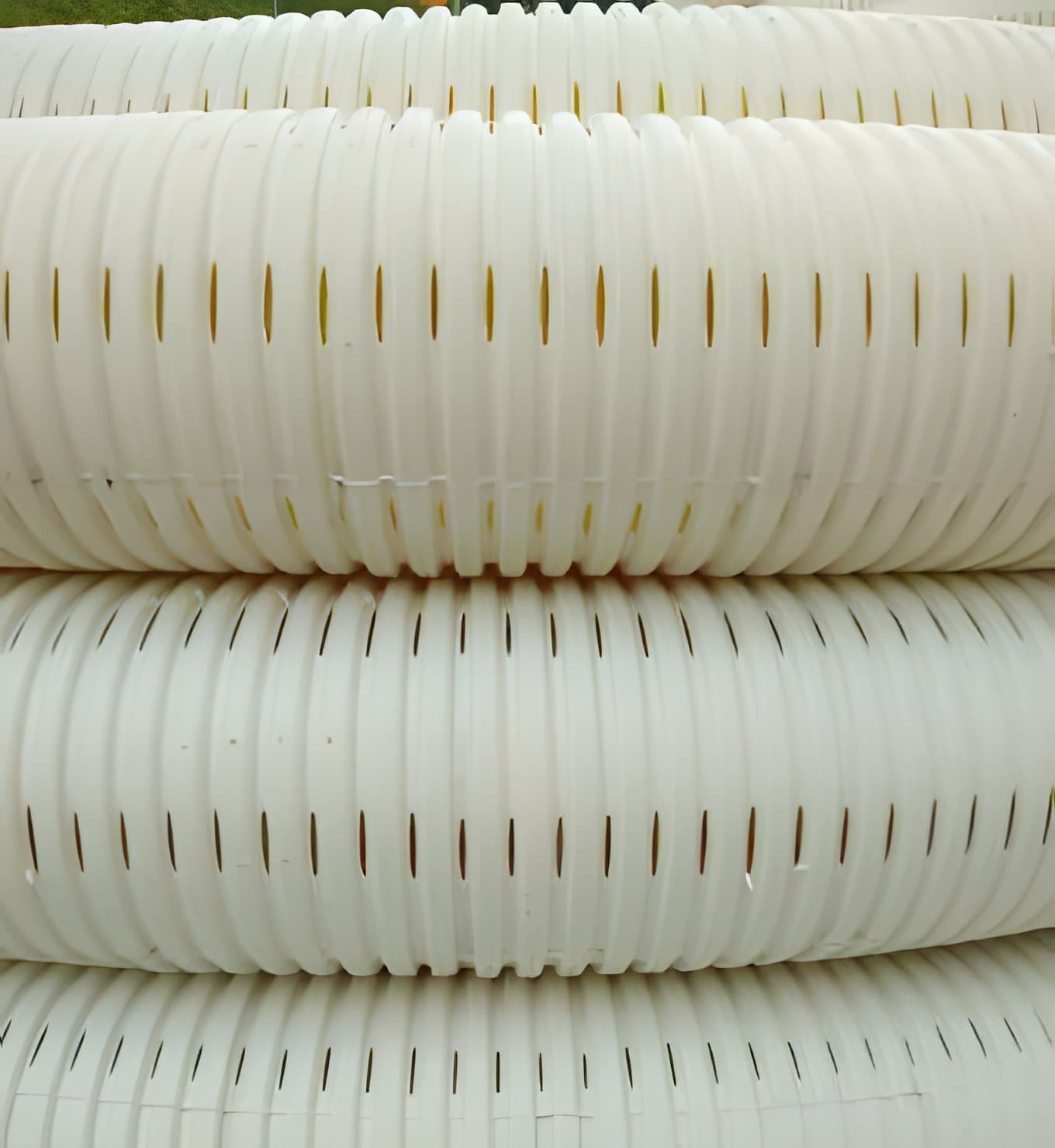
At a Glance
- Function
- Collects water from the soil — perforated, not sealed
- Perforation
- DIN 4262-1
- Diameters
- DN 110 · 160 · 200 mm
- Supplied in
- Coils of 100 m (110) · 50 m (160) · 25 m (200)
- Burial depth
- Can be buried deeper than 2.5 m
- Soils
- Any degree of acidity · clay through high-organic
Drainage Line Specifications
Dimensions and Perforation — DIN 4262-1
Maximum drainage area is the total water-entry opening per linear meter of pipe, which is what sets how much water the drain can take in.
| DN (mm) | OD (mm) | Coil (m) | Min. perf. width (mm) | Perf. count | Perf. length (mm) | Max. drainage area (mm²/m) |
|---|---|---|---|---|---|---|
| 110 | 110,0–110,4 | 100 | 1,5 | 12 | 6 | 9180 |
| 160 | 160,0–160,5 | 50 | 1,5 | 14 | 6 | 7810 |
| 200 | 200,0–200,5 | 25 | 1,5 | 18 | 6 | 8260 |
The perforation count is per pipe section under DIN 4262-1. The trench filter criterion — graded gravel or geotextile — is set by the drain design; tell us what the job calls for when you ask for a quote.
Where Subsurface Drainage Operates
The underlying job is the same everywhere: pull excess water out of the soil profile before it drowns the root zone or undermines the structure.
Row crop agriculture
Lateral drains in crops where excess water caps the yield — 110 mm on laterals, 160 and 200 mm on collectors.
Soil recovery
Ground that waterlogs because of low permeability and produces again once it is drained.
Water table control
Pulling the water table down to a depth where roots can work, in any soil type.
Civil works
Backfill drainage behind retaining walls, slopes, and subgrades, where water pressure is the actual problem.
Fields and landscaping
Sports fields, parks, and landscaping that have to be usable soon after rain.
Ag supply and hardware
Steady counter turnover on 110 mm coils in farming regions.
The Perforation
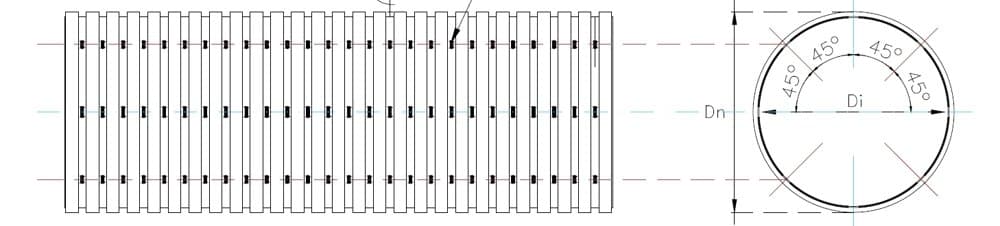
Longitudinal and cross section of the pipe: the slots are distributed around the perimeter so water is collected the whole way round, not only from below.
Buying Subsurface Drainage Pipe Wholesale — FAQ
Why is this pipe perforated?
Because its job is to collect, not to convey. Water saturating the soil enters through the perforations along the whole run, and only then does the pipe carry it to the outlet. A sealed pipe buried in a waterlogged field does nothing: the water stays outside. The perforations under DIN 4262-1 are the whole point of the product, not a defect.
How is it different from Type B corrugated and from drain pipe?
The other two are sealed. Type B corrugated is sewer pipe: it moves buried flow with nothing entering or leaving through the wall. Solid-wall drain pipe is the sanitary installation inside the building. This one is a drain: it picks water up out of the soil. Put perforated drainage pipe in a sewer collector and you get infiltration; put sealed pipe in a field and it drains nothing.
How deep can it be buried?
Its corrugation lets it be buried deeper than 2.5 m. That is what the corrugated profile is for: the same principle that gives ring stiffness in the sewer line here lets a light, flexible pipe carry the soil column above it. The actual design depth is set by drain spacing and by how far down the water table has to be pulled.
Does it resist agrochemicals and acid soils?
Yes. It resists corrosion and agrochemicals and tolerates any degree of soil acidity. It is used in any soil type, from clay soils to those with high organic matter content — which are precisely the two extremes where water does not leave on its own and where a less stable material would degrade over time.
What does maximum drainage area in mm²/m mean?
It is the total water-entry opening a linear meter of pipe offers, adding up every perforation. At 110 mm that is 9,180 mm²/m, at 160 mm 7,810 mm²/m, and at 200 mm 8,260 mm²/m, with perforations 1.5 mm minimum width and 6 mm long. It is the figure you cross against the drain design flow to settle on diameter and on spacing between lines.
How does it ship and what is the minimum order?
In coils: 100 m at 110 mm, 50 m at 160 mm, and 25 m at 200 mm. The coil is what makes the freight efficient — a container of 110 mm holds a lot of footage. Coverage is by the container; if drainage does not fill one on its own, it combines with the rest of the water and drainage line. Send footage by diameter and the destination and we put the configuration together.
Request a Wholesale Quote
Tell us what you need. We come back with a firm quote with incoterms — the team that builds it is the same team that answers your questions.