
RIVAL PVC Conduit Line — Heavy Type for Walls and Slabs
Heavy-type PVC conduit for runs embedded in walls and poured into slabs. Three trade sizes, 1/2", 3/4", and 1", in 3-meter useful lengths with a spigot-bell (E/C) end, so every joint is a solvent-cemented push-fit with no separate coupling.
Self-extinguishing PVC that does not carry flame, a smooth interior that will not nick the insulation on the pull, and an airtight cemented joint. Voltiera is the official RIVAL distributor and ships the line by the full container or mixed with THHN, canalization pipe, and RIVALFLEX to Latin America and the Caribbean.
Request a Quote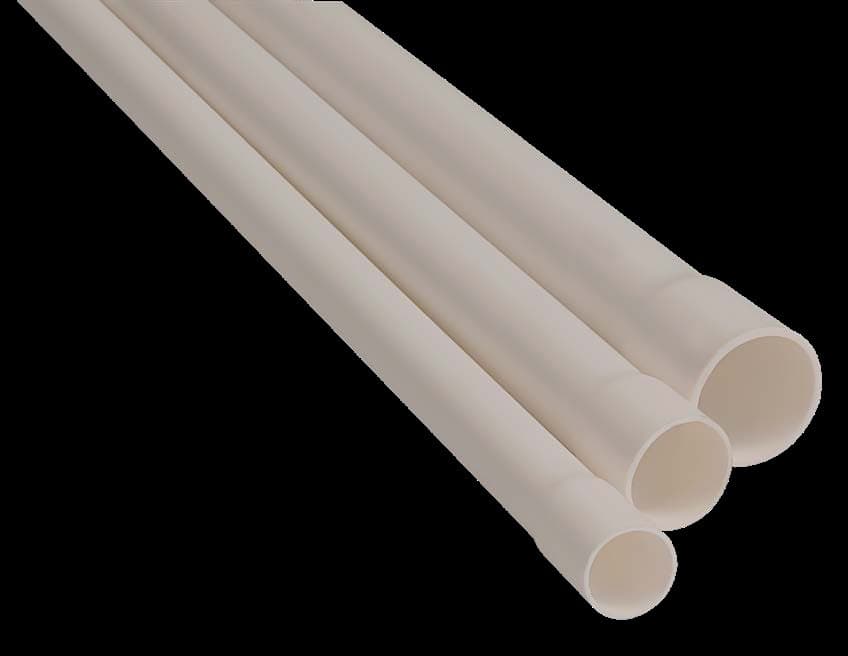
Conduit Line Specifications
Available Diameters
Nominal dimensions of the RIVAL conduit line, subject to manufacturing tolerances. All heavy type, in 3 m useful lengths.
| Nominal size | Min. outside Ø | Wall | Length | Lengths per bundle |
|---|---|---|---|---|
| 1/2" | 17.98 mm | 1.0 – 1.15 mm | 3 m | 25 |
| 3/4" | 23.37 mm | 1.25 – 1.40 mm | 3 m | 15 |
| 1" | 29.47 mm | 1.50 – 1.65 mm | 3 m | 10 |
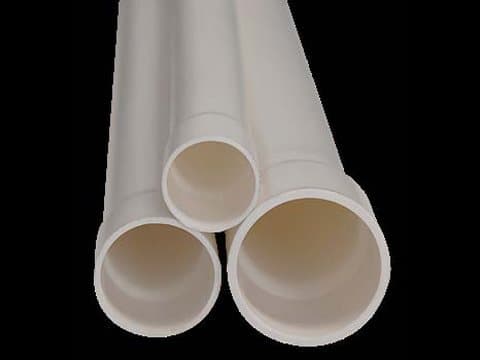
1/2", 3/4", and 1" — smooth inside and out.
Characteristics
Easy installation
Lower cost and faster progress on site: the main advantage of the conduit line over other canalization systems.
Easy wire pulling
A completely smooth interior, so there is no risk of damaging the cable insulation on the pull.
Impact resistant
Selected raw material and a formulated PVC compound, extruded under tightly controlled conditions.
Safety
PVC does not conduct electricity; the pipe itself insulates against electric shock.
Fire resistance
Self-extinguishing: it does not propagate flame, where polyethylene pipe ignites and carries fire.
Airtight joint
Solvent cement in the E/C bell makes a watertight joint with good installation yield.
Conduit Line vs. Canalization Pipe vs. RIVALFLEX
Three RIVAL PVC lines for three different jobs. Most buildings use more than one.
| Conduit line | Canalization pipe | RIVALFLEX | |
|---|---|---|---|
| Build | Rigid, heavy type | Rigid, Type I and Type II | Flexible corrugated, light type |
| Sizes | 1/2" – 1" | 16 – 160 mm | 20 – 50 mm |
| Comes in | 3 m lengths, belled | Rigid lengths | 25 and 50 m rolls |
| Where it goes | Embedded in walls and slabs | Underground telephone and electrical canalization | Light-duty runs that change direction |
| This page | See canalization pipe | See RIVALFLEX |
The bell does math too.
Every 3 m length comes with its own bell, so the joint is pipe to pipe. On a 300 m run that is about a hundred couplings you do not buy and do not carry to the site. On a building with hundreds of outlets, it shows up in the landed cost.
Buying PVC Conduit Wholesale — FAQ
What is the RIVAL PVC conduit line used for?
Electrical runs embedded in walls and poured into slabs. It is heavy-type PVC conduit in 1/2", 3/4", and 1", in 3-meter lengths with a belled end, so the pipe goes into the block wall or the slab and the wire gets pulled through later.
How is it different from RIVAL canalization pipe and RIVALFLEX?
Three lines, three jobs. The conduit line is rigid, heavy-type, 1/2" to 1", for walls and slabs. The canalization pipe runs 16 to 160 mm for underground telephone and electrical canalization. RIVALFLEX is flexible corrugated conduit in 20 to 50 mm rolls for light-duty runs that change direction. Most buildings use more than one.
How do the joints work?
Each 3 m length has a spigot end and a bell end (E/C). Clean both, apply PVC solvent cement, and push the spigot fully into the bell. The cemented joint is airtight and watertight, and there is no separate coupling to buy.
What does "heavy type" mean here?
A thicker wall for pipe that gets buried in concrete or masonry: 1.0 to 1.15 mm on the 1/2", 1.25 to 1.40 mm on the 3/4", and 1.50 to 1.65 mm on the 1". It is built to survive the pour and the vibration, not just to hold wire.
Is it self-extinguishing?
Yes. The PVC compound is self-extinguishing and does not propagate flame, which is one of the main reasons electrical canalization uses PVC instead of polyethylene pipe.
Can I use it on a US project?
This line ships to Latin American and Caribbean projects. US jobs typically call for UL 651-listed PVC conduit; if yours does, talk to us before you spec it.
What is the minimum order?
No fixed minimum. It ships in bundles of 25, 15, and 10 lengths by diameter, by the full container or mixed with THHN, canalization pipe, or RIVALFLEX. Send the diameters, the meters, and the destination and we put the load together.
Request a Wholesale Quote
Tell us what you need. We come back with a firm quote with incoterms — the team that builds it is the same team that answers your questions.