
Plastic Traffic Barriers, Drums, and Delineators — MDPE, Reflective, Interlocking
Medium-density polyethylene road safety line — tubular delineators, weighted drum cones, water-filled barriers, the pivoting Premium Channelizer (90°), and the High Road Barrier for sign-panel deployment. Reflective tape factory-applied, interlocking anchor between units, ship stacked and empty to fill on-site.
Eight SKUs in the line covering lane shifts, work-zone perimeters, parking control, event channelization, and industrial zones. High-visibility orange UV-stabilized through the wall thickness — does not fade in sun and weather. Custom signs available on order. Factory Direct by the container.
Request a Quote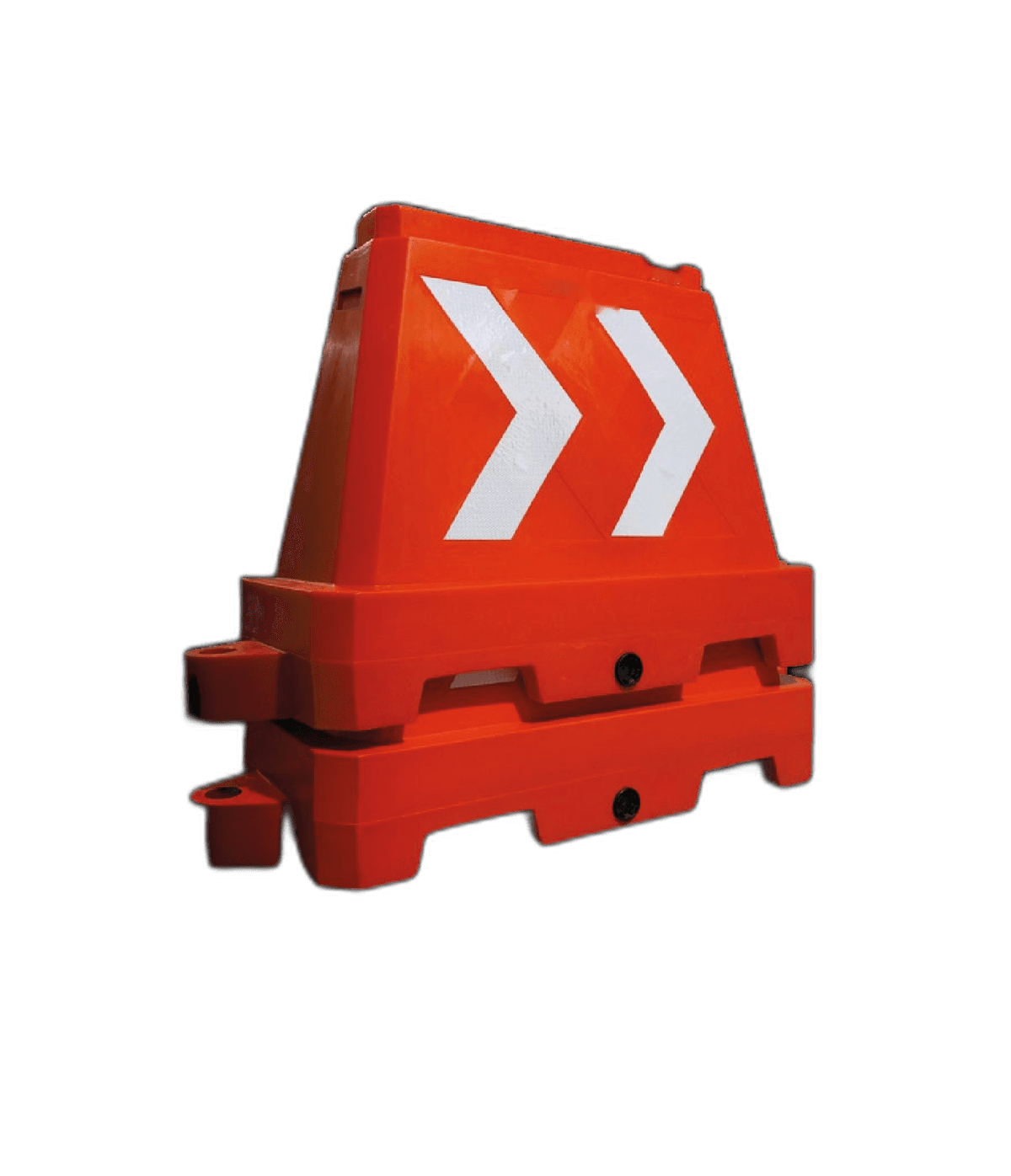
Safety Line Specifications
Product Family — 8 SKUs
Delineators and drums for light channelization, signaling barriers for work zones, a pivoting premium channelizer, and the High Road Barrier for sign panels. Each SKU orders individually or as a mix by the container.
Tubular Delineator
Hollow channel post
- Weight
- 4.4 lb (2.0 kg)
- Base
- 13.2" × 13.2" (335 × 335 mm)
- Height
- 60.0" (1,525 mm)
- Material
- MDPE
Lightweight channelizing post for lane shifts, merges, and detours. Reflective bands for day and night visibility. Easy to deploy and recover.
Drum Cone T1
Weighted channelizer
- Weight (incl. plaster ballast)
- 13.2 lb (6.0 kg)
- Base Ø
- 19.7" (500 mm)
- Height
- 38.8" (985 mm)
- Material
- MDPE
Cone-form channelizer with permanent plaster ballast in the base for wind stability. Reflective tape and lift handles standard. No water fill — plaster is sealed inside the base.
Cylinder Drum T2
Hollow barrel
- Weight
- 13.2 lb (6.0 kg)
- Base Ø
- 28.1" (714 mm)
- Height
- 40.2" (1,020 mm)
- Material
- MDPE
Wider profile than the T1 for higher visibility at distance. Hollow body — fills with water or sand on-site for ballast. Standard traffic-drum geometry for lane closures and work-zone perimeters.
Signaling Barrier T1
Low profile
- Weight
- 17.6 lb (8 kg)
- Base
- 57.2" / 51.2" × 15.0" (1,454 / 1,300 × 380 mm)
- Height
- 23.0" (585 mm)
- Material
- MDPE
Low-profile barrier for sidewalk-level lane closures, pedestrian channelization, and short-duration work zones. Anchor system between units; base shown with / without interlock socket.
Signaling Barrier T2
Window profile
- Weight
- 30.9 lb (14 kg)
- Base
- 70.9" × 17.7" (1,800 × 450 mm)
- Height
- 35.4" (900 mm)
- Material
- MDPE
Standard work-zone barrier with window cutouts for visibility through the line. Stacks for transport and storage; interlocks for continuous runs.
Stackable Directional Barrier
Chevron · directional
- Weight
- 37.5 lb (17 kg)
- Base
- 53.9" × 18.9" (1,370 × 480 mm)
- Height
- 31.9" (810 mm)
- Material
- MDPE
Chevron-arrow face for directional guidance — lane shifts, detours, and merge points. Stacks and interlocks like the Signaling T2.
Premium Traffic Channelizer
Pivoting · up to 90°
- Weight
- 61.7 lb (28 kg)
- Base
- 78.7" × 17.7" (2,000 × 450 mm)
- Height
- 39.4" (1,000 mm)
- Material
- MDPE
- Features
- Water circulation between units · 90° interlock socket
Heavier channelizer with pivoting interlock — connects units in straight runs or up to 90° curves. Water circulates between connected units for stability.
High Road Barrier
Sign panel ready
- Weight
- 55.1 lb (25 kg)
- Base
- 55.1" / 47.2" × 15.7" (1,400 / 1,200 × 400 mm)
- Height
- 57.1" (1,450 mm)
- Material
- MDPE
- Features
- Large sign / tape area · water drain
Tallest barrier in the line. Large vertical face for sign panels and reflective tape. Base shown with / without interlock socket; water-fill drain for relocation between sites.
Where the Safety Line Operates
The line is sized for environments where traffic channelization, work-zone separation, and directional guidance are part of daily operations.
Roadwork and lane closures
Resurfacing, repavement, and utility work — high-visibility barriers and drums channel traffic safely around the work front.
Construction sites
Cordoning off active zones, excavations, and equipment with interlocking barriers that form continuous perimeters.
Traffic channelization
Delineators and the pivoting channelizer guide vehicles through lane shifts, merges, and detours.
Parking and access control
Lightweight cones and posts manage flow in lots, gate houses, and pedestrian crossings.
Events and crowd control
Quick to deploy and relocate — water-fill barriers create temporary lanes and queue lines.
Industrial and warehouse
Hazard marking, restricted forklift zones, and separation of foot traffic from machinery, indoors and out.
Buying the Safety Line Wholesale — FAQ
What is a water-filled barrier and where is it used?
A water-filled barrier is a hollow MDPE channelizer or barrier that ships empty (light, stackable for transport), then fills with water on-site through a top port to gain mass and stability. The water drains back out for relocation. It is the standard work-zone barrier for roadwork, construction sites, lane shifts, parking control, and event channelization where a permanent concrete barrier is not the right answer. (Note: in this line the Drum Cone T1 ships with sealed plaster ballast — water-fill applies to barriers and channelizers only.)
What is the difference between a traffic drum and a traffic cone?
A traffic cone is a one-piece molded marker, smaller (typically 28–36 in) and lighter. A traffic drum is a larger channelizing device (39–41 in tall in this line) with a wider base and higher visibility from a distance. Cones are for short-duration low-speed work; drums are for higher-speed road work and longer work-zone exposures.
How does the interlocking system work between barriers?
Each barrier and channelizer has anchor points molded into the ends. Units connect end-to-end to form continuous straight runs; the Premium Traffic Channelizer pivots up to 90° at the interlock for curved deployments. The interlock is mechanical (no tools required on most units) and keeps the line aligned under wind and incidental contact.
Are these barriers MUTCD or NCHRP-350 / MASH compliant?
These are MDPE work-zone devices positioned on spec — material, weight, base footprint, height, and reflective tape. US work-zone compliance (MUTCD for channelizing devices, NCHRP-350 or MASH for crashworthiness on certain barrier classes) varies by jurisdiction, device type, and intended use. We do not publish blanket compliance claims; for projects where AHJ certification is a hard requirement, send the spec and we confirm against the device class before order.
Can the barriers be moved with a forklift?
Yes — the larger barriers (Stackable T2 and up) include forklift-fork access in the base, and all units are stackable and nestable for transport. The Tubular Delineator and Drum Cone T1 are light enough (4–13 lb) for manual handling; the High Road Barrier (55 lb empty) and Premium Channelizer (62 lb empty) move under forklift on the site.
Does the line come with reflective tape standard?
Yes. Every unit ships with weather-resistant high-reflectivity tape pre-applied in the appropriate location for the device class — vertical bands on delineators and drums, horizontal bands on barriers, chevron-pattern on the directional barrier. Tape returns headlight beams day and night for work-zone visibility.
What is the difference between the Signaling Barrier T2 and the Stackable Directional Barrier?
The Signaling Barrier T2 is the work-zone standard — window cutouts in the face for visibility through the line. The Stackable Directional Barrier replaces the windows with a chevron-arrow graphic for directional guidance at lane shifts, merges, and detour points. Same MDPE body, similar weight class, different face function.
What is the minimum order for safety-line products by the container?
No fixed minimum on unit count. The honest question is whether the math works for a full container of safety-line devices or whether a mixed container with plastic pallets, PVC SCH 40, or insulated bins gets to a better landed cost. Send the SKU mix and the destination — we put the configuration together that gives the best total cost.
Request a Wholesale Quote
Tell us what you need. We come back with a firm quote with incoterms — the team that builds it is the same team that answers your questions.