
Insulated Bins — Fish Totes for Cold-Chain Operations
Double-wall insulated bins (also called fish totes or insulated totes) sized for the Florida fish supply trade and Pacific-coast shrimp farming. Three models in 700L and 1000L, food-grade polyethylene with polyurethane foam insulation, ANSI/NSF 2 certified.
They hold the cold chain without a refrigerated trailer, move under a forklift or pallet jack, and ship with a drain plug system, 4-corner handles, and a wide area for custom branding and color. Factory Direct by the container — order by model or mixed with plastic pallets and other plastics-line products.
Request a Quote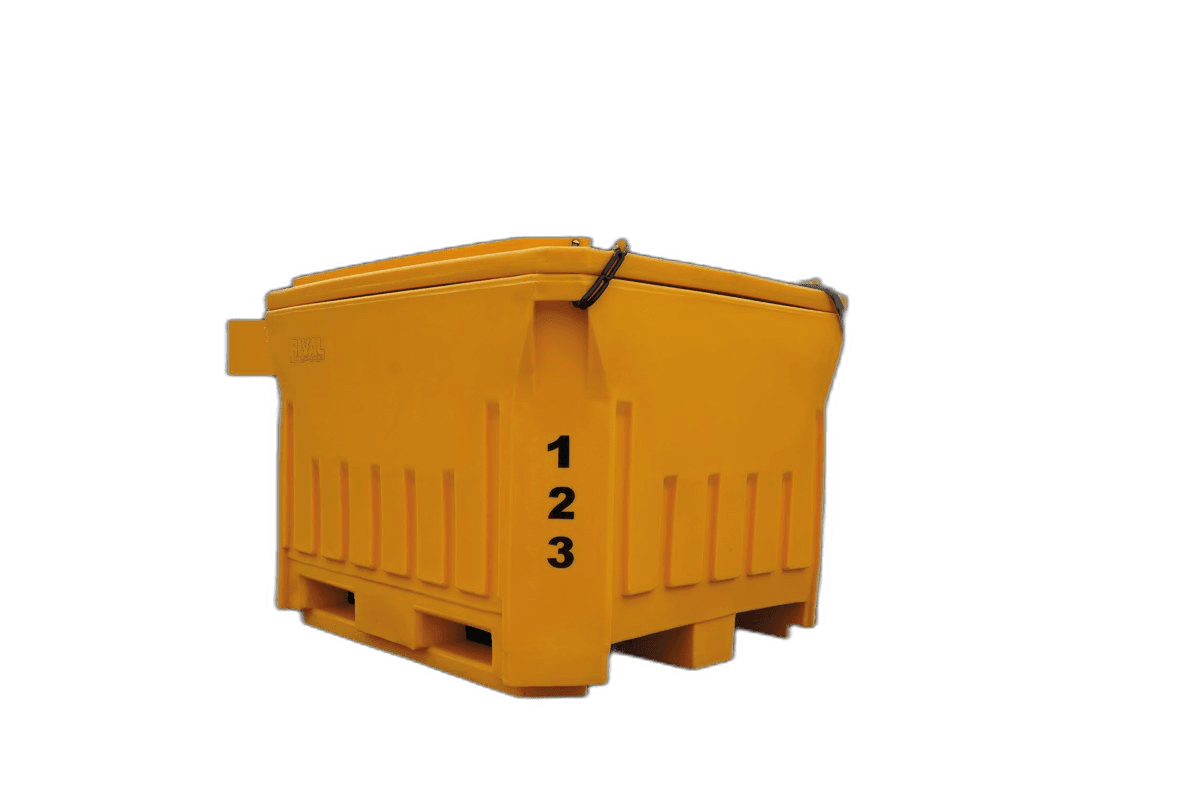
Insulated Bin Specifications
Three Models · 700L and 1000L
Three models in the line, two capacities (700L and 1000L), and three geometries so the bin matches the operation — processing line, deep transport, or balanced transport for stacking efficiency.
Model 1 — Tall-Wall Bin · 1000 L
- Outer body
- 48.4" × 43.3" × 45.6" — 1229 × 1100 × 1157 mm (L × W × H)
- Inner body
- 44.0" × 39.0" × 37.8" — 1118 × 990 × 960 mm
- Total height (body + lid)
- 47.6" (1208 mm)
Square footprint with vertical-wall profile for deep loads. Liter scale molded into the inside wall. Lid included.
Model 2 — Cubic Bin · 1000 L
- Outer body
- 42.7" × 47.9" × 46.5" — 1085 × 1218 × 1180 mm (L × W × H, including feet)
- Inner body
- 38.4" × 38.6" × 38.6" — 975 × 980 × 980 mm
- Total height (body + lid)
- 47.8" (1215 mm)
Cubic profile sized for balanced loads and stacking efficiency in transit. Same 1,000 L capacity as Model 1, different aspect ratio.
Model 3 — Low-Profile Bin · 700 L
- Outer body
- 48.2" × 40.9" × 29.9" — 1225 × 1040 × 760 mm (L × W × H, including feet)
- Inner body
- 45.9" × 38.6" × 24.0" — 1165 × 980 × 610 mm
- Total height (body + lid)
- 31.9" (809 mm)
Low-profile body for plant-floor operation and ergonomic loading. 4-corner handles and wide custom-branding area. Stacks for storage and return logistics.
Where Insulated Bins Operate
The line is sized for industries where temperature is part of the spec and a refrigerated trailer is not always the right answer.
Florida fish supply trade
Whole fish, fillets, and shellfish from the dock to the processor to the distributor. The Florida seafood industry is the named demand pocket the line targets in the United States.
Pacific-coast shrimp farming
Shrimp harvest, transport from the farm to the processing plant, and plant-floor operation. The wedge buyer on the Central American Pacific coast.
Seafood processing line
Filleting, deheading, and cleaning. The Low-Profile bin sits at waist height for the operator; Tall-Wall and Cubic load for transport.
Aquaculture operations
Grow-out, live transport, and fresh product handling. Food-grade polyethylene for direct contact and ANSI/NSF 2 certification.
Cold chain without refrigeration
Long hauls where running a refrigerated trailer costs more than it saves. Double-wall insulation holds the ice temperature through the route.
Dairy, vaccines, fresh product
Any category where temperature is part of the spec and lot-level traceability is required.
How to Pick the Model
Three models, three operations. Most fish-supply accounts ship a mix of all three — Low-Profile at the plant, the 1000L pair for transport.
For maximum capacity per footprint and deep loads. Square footprint that uses the vertical space inside the container.
For balanced loads and stacking efficiency in transit. Same 1000L capacity with a different aspect ratio than the Tall-Wall.
For plant-floor operation and ergonomic loading at waist height. 4-corner handles and wide custom-branding area.
Buying Insulated Bins Wholesale — FAQ
What is an insulated bin or fish tote and what is it used for?
An insulated bin — sometimes called a fish tote or insulated tote — is a double-wall polyethylene container with polyurethane foam insulation that holds the cold chain without a refrigerated trailer. The Florida fish supply trade uses them to move whole fish, fillets, and shrimp from the dock to the processor to the distributor. Aquaculture operations on the Pacific coast use them the same way for shrimp harvest.
Are the bins food-grade and ANSI/NSF 2 certified?
Yes. The bins are manufactured in food-grade polyethylene certified for direct contact with fish, shrimp, and fresh product, and the product line carries ANSI/NSF 2 certification (food equipment). Certificate and lot-level traceability ship with the order.
How long does an insulated bin hold the cold chain?
Hold time depends on ambient temperature, the ratio of product to ice, and how often the lid opens — there is no honest single number. The double-wall construction with thick polyurethane foam on body and lid extends cold-chain life far beyond a single-wall plastic bin, which is why the line is sized for long-haul transport without refrigeration. For your specific haul, run the math with your seafood processor or send the conditions and we can give a working estimate.
Which model size should I order — 700L, 1000L Tall-Wall, or 1000L Cubic?
The 700L Low-Profile is for plant-floor operation and ergonomic loading where the operator works at waist height. The 1000L Tall-Wall is for deep loads and maximum capacity per footprint. The 1000L Cubic is for balanced loads where stacking efficiency in transit matters more than vertical depth. Most fish-supply accounts mix sizes — Low-Profile at the processing line, Tall-Wall or Cubic for transport.
Can the bins be moved with a forklift or pallet jack?
Yes. Side pockets are sized for forklift tines and manual pallet jacks, and there are handles on all 4 corners for manual handling and rigging. The bin moves under a loaded forklift or under hand power at the plant.
Can I order custom colors or with our logo molded in?
Yes. The bins are available in the full color range — yellow, blue, red, black, custom — and there is a wide area on the side for your logo, brand mark, or color-coding scheme. Custom branding and color are specified on the PO; production runs against the order rather than from stock.
What is the difference between an insulated tote and a regular plastic bin?
A regular plastic bin is a single-wall container — it holds product, not temperature. An insulated tote is double-walled with foam insulation between the walls, so it holds the cold chain on its own. For seafood, dairy, vaccines, and any product where temperature is part of the spec, the insulated tote is the only honest answer.
What is the minimum order for insulated bins by the container?
There is no fixed minimum on bin count. The honest question is whether the math works for a full container of bins or whether a mixed container with plastic pallets, PVC SCH 40, or electrical material gets to a better landed cost. Send the model mix and the destination — we put the configuration together that gives the best total cost.
Standards & References
Request a Wholesale Quote
Tell us what you need. We come back with a firm quote with incoterms — the team that builds it is the same team that answers your questions.